AAVIS Architecture: Autonomous AV Commissioning as a Local Agent System
AAVIS Architecture: Autonomous AV Commissioning as a Local Agent System
Working Title
AAVIS Architecture for Local AI-Driven AV Commissioning
Environment
- System concept: AAVIS / Autonomous AV Integration System
- Runtime target: Local Windows workstation
- AV domains: Network commissioning, control programming, CH5 UI generation, documentation, testing, voice control
- Orchestration: Local multi-agent workflow
- Source input: Written scope of work and project documents
- Author: Darrell Cowan
- Publisher: AV Edge Tech
- Hardware: Windows workstation with GPU, dual NIC, local storage
- LLM runtime: Unknown
- Production status: Concept / development workflow
Problem Statement
AV commissioning is still heavily manual. A programmer or commissioning specialist interprets the scope of work, discovers devices, configures the network, writes control code, builds touch panel interfaces, tests device behavior, and documents the final system.
The result is expensive, slow, and difficult to repeat. The knowledge behind the system often lives in the programmer's head instead of in a maintainable technical record.
AAVIS, the Autonomous AV Integration System, is a proposed architecture for moving this work into a local AI-assisted agent system. The system does not replace engineering judgment. It creates a structured workflow where agents can read project intent, access technical sources, generate artifacts, validate results, and maintain documentation over time.
Core Architecture
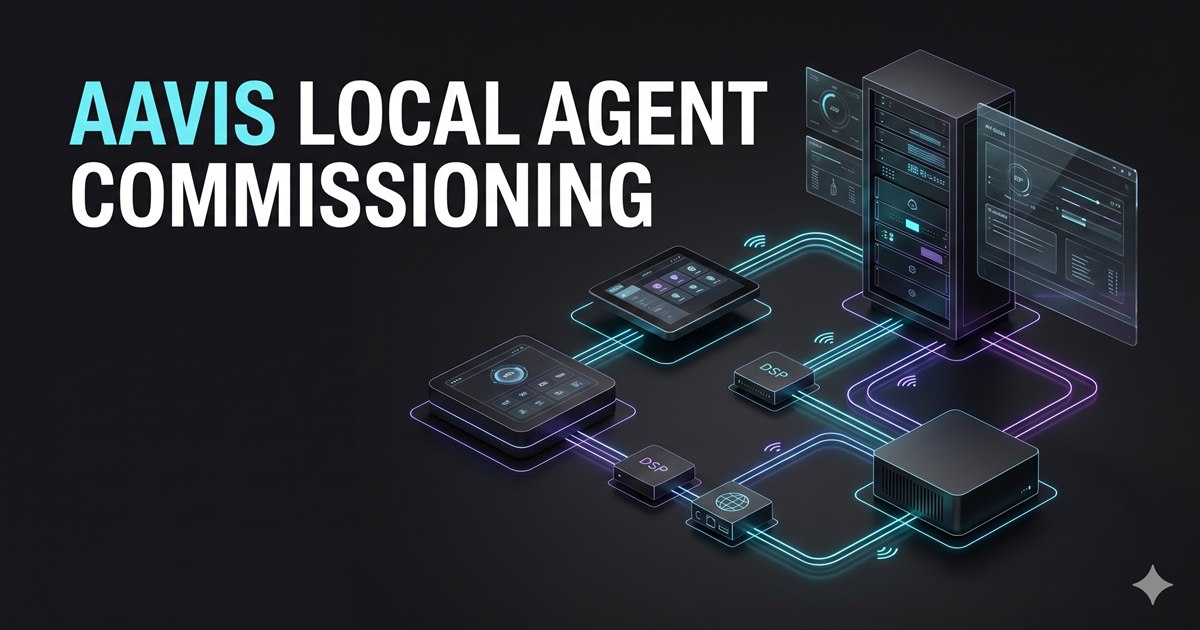
AAVIS is built around a local workstation that acts as the commissioning command center. The workstation runs the AI runtime, orchestration layer, protocol adapters, project document index, and reporting tools.
Scope of work + drawings + device docs
  -> Document ingestion
  -> Multi-agent orchestration
  -> AV domain reasoning
  -> Network and control adapters
  -> Generated code, UI, reports, and tests
  -> Human review and deployment
The local-first model matters because many AV job sites have strict privacy, security, or connectivity requirements. A commissioning workflow should not depend on permanent cloud access to function.
Major System Layers
A practical AAVIS-style architecture can be divided into five layers:
Voice and input layer
  Offline speech recognition, wake word detection, operator prompts

Orchestration layer
  Workflow engine, task routing, agent coordination, job state

AI reasoning layer
  Local or private model endpoint, AV prompt architecture, tool selection

Protocol adapter layer
  SSH, SNMP, REST APIs, serial, TCP, Crestron tooling, Q-SYS APIs

Output layer
  Control code, CH5 UI, test reports, manuals, support documentation
Each layer should be replaceable. The architecture should not depend on one model vendor, one ticketing platform, or one AV manufacturer.
Commissioning Workflow
A typical commissioning cycle could follow this pattern:
- Import the project scope, drawings, device list, and network requirements.
- Extract rooms, endpoints, control requirements, and assumptions.
- Discover devices on the local network using approved protocols.
- Compare discovered devices against the intended design.
- Generate switch configuration recommendations.
- Assemble control logic from vetted module libraries.
- Generate or update the touch panel interface.
- Run functional tests and log results.
- Produce handoff documentation.
- Preserve the project state for future service tickets.
The key is that the workflow should preserve the reasoning trail. Every generated artifact should be traceable back to a source document, device response, test result, or human approval.
Why Local Agents Matter
Cloud models can be useful, but local execution gives AV integrators stronger control over:
- Client confidentiality
- Offline job sites
- Government and defense environments
- Recurring API cost
- Latency
- Data retention
- Toolchain stability
For many AV projects, the system should be able to continue operating even when the internet connection is unavailable.
Human Review Points
AAVIS should include human approval at important boundaries:
- Before applying switch configuration changes
- Before deploying control code
- Before publishing client-facing documentation
- Before closing commissioning defects
- Before sending support instructions to a customer
Autonomous does not mean reckless. The practical model is supervised autonomy: the agents do the heavy lifting, and the AV professional approves the parts that affect the live system.
Publisher Note
Author: Darrell Cowan Publisher: AV Edge Tech
Published by Darrell Cowan of AV Edge Tech as part of an ongoing technical documentation effort around AI-assisted AV development, commissioning automation, and maintainable control system workflows.
Implementation Notes
An AAVIS-style workstation should be specified around the actual commissioning workload, not around a generic AI hardware list. The practical requirements are:
- Enough local compute to run the selected model or private inference endpoint
- Reliable access to project files, device documentation, and code repositories
- Network interfaces that can safely reach the commissioning VLANs being tested
- Clear separation between client data sets
- A human approval step before any generated configuration or control code is deployed
The hardware choices should follow the site requirements, client security rules, and the AV toolchain already used by the integrator.
Final Takeaway
AAVIS is best understood as a local agent architecture for turning project documents into commissioned AV system artifacts. The system reads intent, coordinates specialized agents, generates technical outputs, validates against real devices, and preserves the project knowledge for future support.
That combination is what makes the idea powerful: commissioning, documentation, and maintenance become one continuous workflow instead of separate manual tasks.